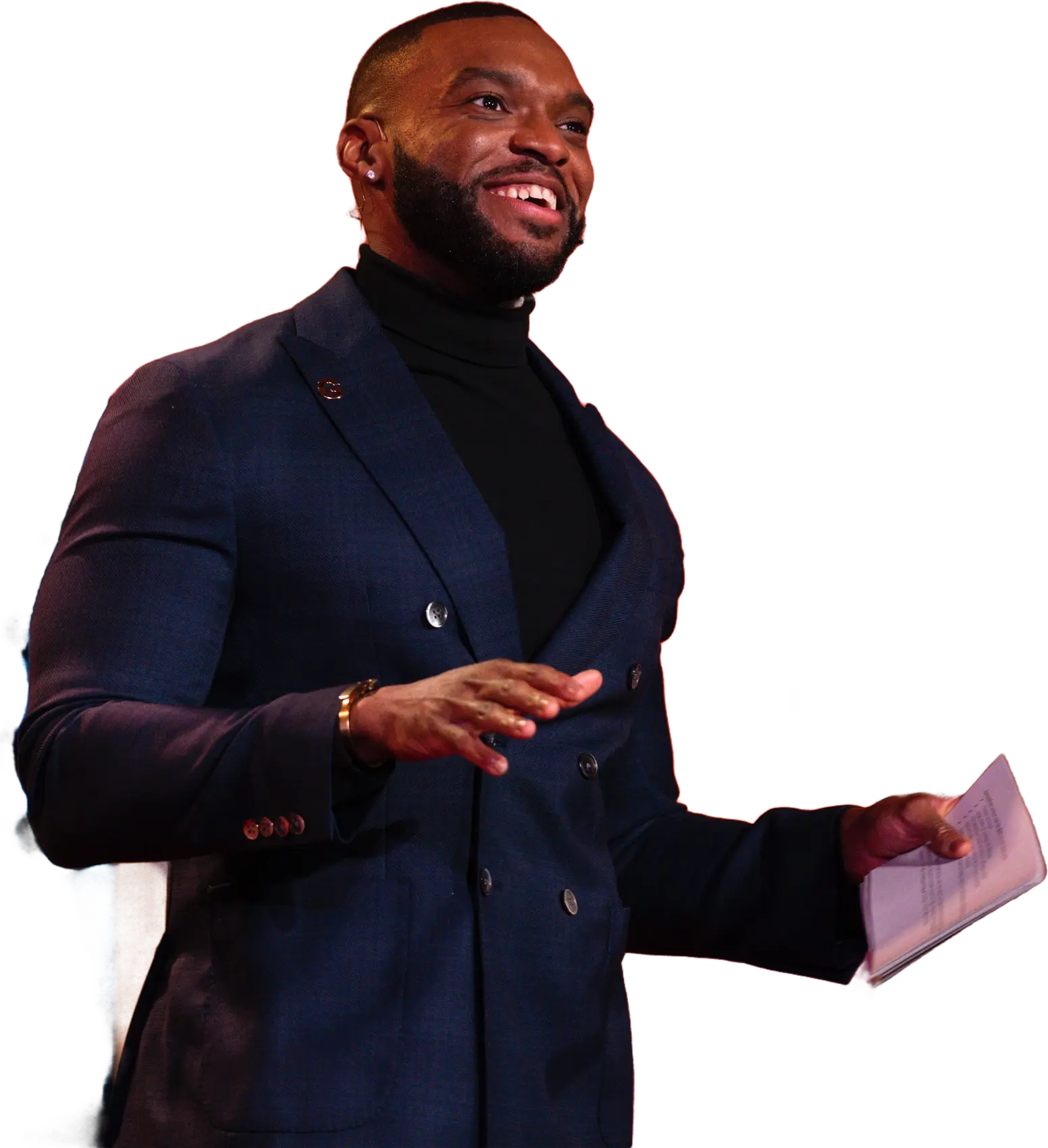
I learned to read, write, and speak in the orbit of D.C. jails. I was never incarcerated, but my father worked in corrections, and one of his quiet rituals was bringing home the books that circulated through the cells. That's how my older brother and I, young, came to The Autobiography of Malcolm X, the speeches of Dr. King, and my own first love, Harry Potter.
Before I understood it as a craft, I was surrounded by it. Pastors, organizers, educators, my father: people who could walk into a room and move it. I watched, and I marveled. Oration, I learned early, is the power to influence, inspire, and mobilize through words, through voice, through presence. It is as much performance as it is the clear, unguarded articulation of an idea.
I studied creative writing at Gonzaga, in a small program that let me sit close to working authors, playwrights, and storytellers.
Read more
Close enough to learn how a thing on the page actually gets made. Sociology gave me the other half of the lens: a way to see people in systems and patterns, the architecture beneath how we relate. Story and structure. Those two skill sets became the ground I built everything else on.
My first chapter was education, and it began as a return. I taught incarcerated youth. The same system that had handed me my love of reading, writing, and oration was now asking me to hand it forward. From there the work widened. I coached educators with Teach for America, using the same instincts I'd always had, the read of a room, the read of a person, to help teachers move their students toward real learning. I became a principal, launching and leading a high school built around leadership, global citizenship, and rigor, where student performance climbed by half on state assessments. I was building people, and building the systems that build people.
Then performance called again. I joined TED, where I coached hundreds of speakers and ran the programs that take a raw idea and shape it into something a room will never forget. I worked with everyone from C-suite executives and artists to activists and the NASA architects imagining human life on Mars. At the height of it, I coached and produced talks that became the #1 and #3 TED Talks of the year in 2023.
Somewhere in there I started my own practice, and I went to Harvard's Graduate School of Education to chase the question underneath all of it: how do adults actually learn to communicate, and why does story move us the way it does? Since then I've taught and facilitated with Harvard Law School's Program on Negotiation as a Teaching Fellow, coaching leaders through the conversations most people avoid. I've also coached talks for Harvard's conferences and fellowships, from the Black Policy Conference to the Zuckerman Fellows to MV3, helping doctors, scholars, and policy minds find the voice their work deserves.
These days I work most closely with founders, CEOs, and anyone trying to tell a truer, sharper story. Coaching the speaker. Shaping the story. Building the talk. The through-line was always the same: I am fascinated by how words move people, and I've spent my life learning to help others move rooms, on and off the stage.
The first of those rooms belonged to my father. His name was Sunday. He was the one who carried those books home, who put the words in my hands long before I knew what they would become. So when it came time to name this practice, there was only one name it could carry. I call it Sunday's Stage. It is the work, and it is the legacy, built in his honor.